Baus Research Highlights #3
Things are on the up-and-up! (play the game or get played)

Summary:
Supply lines are expected to normalize between Q4 ‘21 and H1 ‘22.
Most firms expect a US infrastructure bill of $2T.
Most of Q3 ‘21 is expected to be highly volatile but overall positive for risk assets, especially equities.
First Trust’s fair value model for the S&P 500 forecasts a level of 5240 if US10Y hits 2%.
Two central banks, the Reserve Bank of Australia (RBA) and Reserve Bank of New Zealand (RBNZ), are ending their original COVID stimulus programs. With the RBA ending their program in September and the RBNZ’s program ending this July 23th.
The ECB officially launches their digital euro project.
The BIS Annual Economic Report has a section on CBDCs that was collaborated on by the G10 Central Banks. It describes exactly how CBDCs will be designed to work in the future. (you should read this)
Supply Lines
Things aren’t greener on the other side of this canal.
PIMCO talks about supply bottlenecks easing towards end of year (EoY). Specifically citing semiconductor shortages.1
Fair to say that PIMCO is optimistic compared to IHS Markit, (the group that produce PMI indexes) who expects the supply chains to normalize sometime in 2022.2
Westpac acknowledged that Fed Chair Powell’s testimony was positive in the long run on supply constraints; with current strong demand backing the long term view.3
US Infrastructure and Debt Ceiling
I will make you wish I was partisan.
Wells Fargo expects a $2T - $3T infrastructure bill.4
PIMCO expects $2T - $2.5T and for the debt ceiling increase to pass before Sept 30 to avoid a government shutdown.5
Upcoming Volatility
Speculate? No, I’m just pondering.
BlackRock tells investors that they shouldn’t be surprised if volatility comes on strong as the economy begins to restart.6
UBP says that a combination of the US earnings season and the Federal Reserve’s pivot to a more hawkish stance are the two major factors generating this volatility.7
One reason for this volatility could ultimately be due to longer term valuation models. (hear me out!)
First Trust (FT) came out with a simple, brief article saying that the S&P 500 could go to 5240 if the US 10 Year Yield (US10Y) went to 2%; and if US10Y were to stay the same until the end of this year, then the fair value model by FT says that the S&P could rise another 20% this year. I encourage you to read this one.8
If other funds are making decisions with similar valuation models (likely true), then one way the higher expected market volatility could play out is in a historic rally.
RBA and RBNZ Ending COVID Stimulus
More help for Aussie and Kiwi!
Wells Fargo (WF) did a complete analysis on the RBA, observing that once the RBA completes their current COVID program in September at A$5 billon/week, the bank will reduce purchases to A$4 billion/week until mid-November.
WF expects the AUD to see “only moderate gains” in the “medium-to-longer-term,” so WF does not have a high conviction on the currency appreciating.9
I assume a contributing factor to WF analysis is the Fed’s tightening is now expected to begin around the same time as the RBA tightening. (between Q4 ‘21 - Q1 ‘22)
The RBNZ was much more straight forward. They simply said they will halt their Large Scale Asset Purchase program on this upcoming July 23rd.10
The NZD appreciated in the forex markets on this news. I expect the RBNZ’s policy to stay “ahead of the Fed” with higher cash rates than the Fed looking forward. This should be positive for NZD strength.
ECB Launches Digital Euro
We don’t know exactly what we’re doing quite yet.
The European Central Bank (ECB) is launching their digital euro starting with a 24 month investigation on how to practically implement the thing.11
Specifically, they’ll seek the approval of European Union (EU) politicians and “other decision makers.” The guy in charge of doing this is Fabio Panetta.12
If you would like to understand the assumptions already going into this investigation of a digital euro, consider reading the experimentation work summary.13 It covers 9 months of research leading up to this decision to go ahead on a digital euro.
BIS Annual Economic Report: CBDC Segment
“This is how we control ze world!” “Sir, this is an Arby’s. You have Apple or Google Pay?”
I’ve been following CBDC development extremely close.14
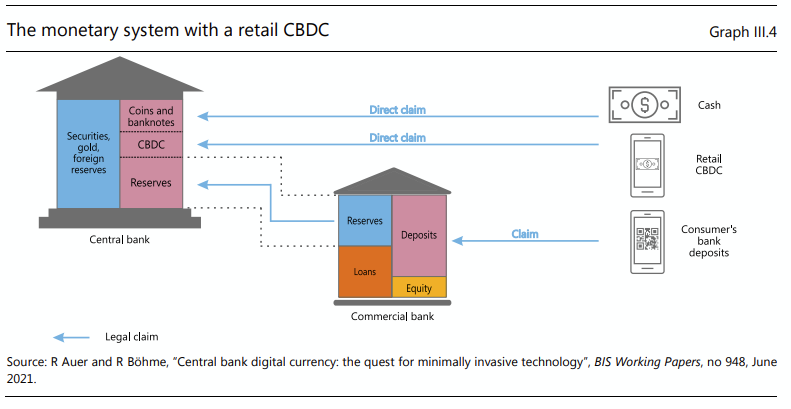
This next diagram is from the Bank of International Settlements (BIS). They have by far published the most simple and transparent explanation of CBDCs so far.15
If you can understand what this one image means, then you’ll have a clear understanding of how (likely) the next 100+ years of money will operate.
(hint: you can read the source I linked for a complete and thorough explanation.)
Thank you for reading! Share and subscribe if you found this newsletter helpful.
If you want to delve deeper into any one of these points feel free to read the sources I cite in the Sources section below.
Sources